No content results match your keyword.
Content

You have successfully logged out.


Not registered yet?
See the invisible. Achieve the impossible.
Spinal navigation has evolved into a transformative technology, offering benefits that amplify surgeons' experiences while improving patient outcomes. Committed to empower surgeons with the most advanced healthcare solutions, B. Braun fuses cutting-edge navigation technologies with its spinal platforms to create a dynamic synergy.
This information is meant for medical professionals only. Please confirm that you are a medical professional before accessing this information.
Confirm Yes, I am a health care professional. Cancel No, I am not a health care professional.
Performance. Precision. Possibilities.
Experience greater efficiency with fewer instruments. Unleash the power of minimalism and enhance your practice with the simplicity and precision of our instruments – because less is truly more.
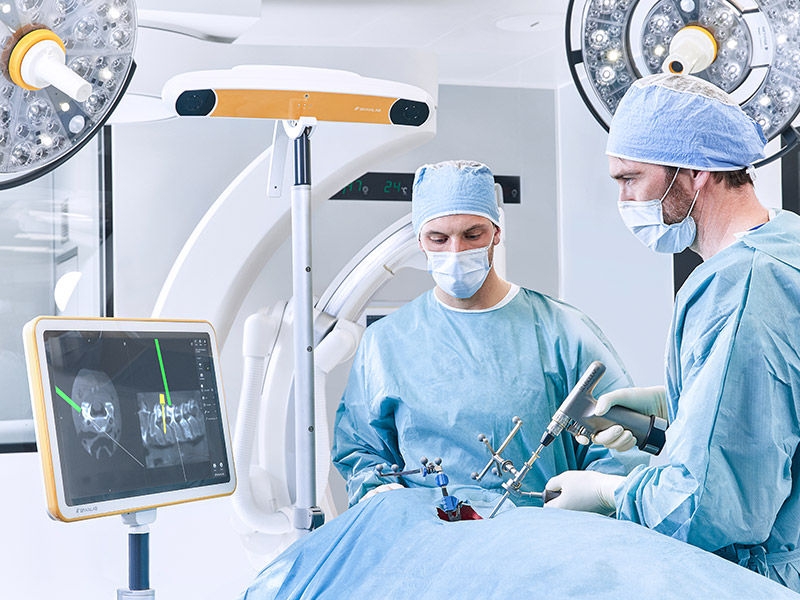
Ennovate® Cervical MIS
The synergy of enriched patient data with the latest minimally invasive technologies adds a new layer of sophistication to surgical procedures. For patients, the minimally invasive nature of Ennovate® Cervical translates into smaller incisions, less morbidity with equivalent surgical outcomes. This not only minimizes post-operative discomfort but also expedites the return to daily activities. [1-4] Surgeons, in turn, experience a paradigm shift in their approach to cervical spine surgery. The visualization and intra-operative guidance enable more confident approaches to complexities. These new opportunities streamline processes, reduce the duration of operations, and enhance overall performance. [5-9]
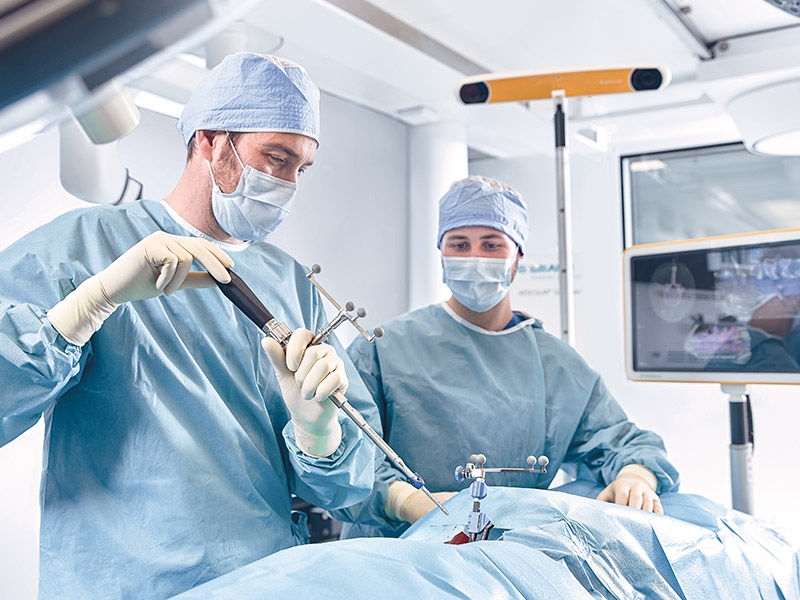
Ennovate® TLSP Drill Guide
The quest for enhanced accuracy and efficiency is a key factor in modern healthcare, and the Ennovate® TLSP Drill Guide rises to the challenge. The streamlined workflow allows surgeons to perform thoracolumbar and sacropelvic procedures with fewer instruments. [10] This simplifies surgical procedures and contributes to a more organized and efficient OR environment. Beyond that, the drill guide additionally allows a pressure-free preparation of the vertebrae, which improves the overall precision along every surgical step. [11]
AESCULAP® 3D Interbody fusion devices
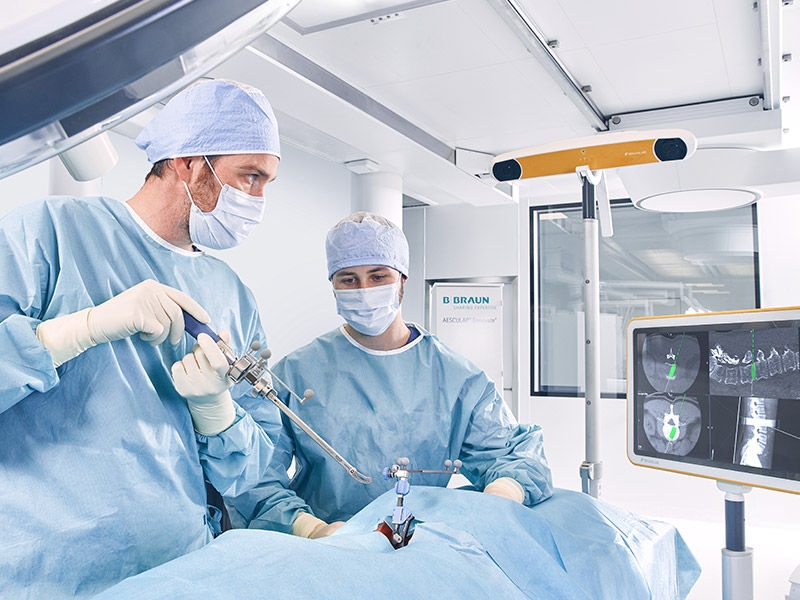
Improving biomechanical performance by optimizing the placement of implants – the role of spinal navigation in interbody fusion surgery is transformative. We aim to achieve best possible implant positioning and enhance biomechanical stability, which are fundamental skills in spinal surgery and crucial for superior long-term outcomes. [12] Equipped with advanced technology, surgeons can navigate our AESCULAP® 3D cages with unparalleled precision, tailoring their approach to each patient's anatomy. [5,11]
Ennovate® Spine Surgery
References


